In young's double slit experiment performed using a monochromatic light of wavelength  , when a glass plate (
  = 1.5) of thickness x
  is introduced in the path of the one of the interfering beams, the intensity at the position where the central maximum occurred previously remains unchanged. The value of x will be:
Text Solution
Verified by ExpertsThe correct answer is:
B
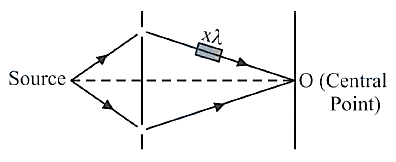
Path difference at  .
.
If the intensity at O remains (maximum)
unchanged, path difference must be n  .
.



For n= 1, x = 2
Prepare Smarter with CGP Edu
Get practice questions, solutions, and test series in one place.
Write a Review
Share your experience with this question and solution.
Commentary
Send your comment, doubt, correction, or feedback to admin.
Similar Questions
Explore conceptually related problems
In free space, an electromagnetic wave of 3 GHz of 3 GHz frequency strikes over the edge of an obje…
For a specific wavelength 670 nm of light coming from a galaxy moving with velocity v, the observed…
Using Young's double slit experiment, a monochromatic light of wavelength 5000 produces fringes of…
Sodium light of wavelengths 650 nm and 655 nm is used to study diffraction at a single slit of aper…
In Young's double slit experiment the two slits are 0.6 mm distance apart. Interference pattern is …
In a Young's double slit experiment, an angular width of the fringe is 0.35° on a screen placed at …